A business is full of knowledge that never fits inside a form.
The owner knows the regulars. The edge cases. The thing customers come back for. The promise they should never make. The reason one photo feels right and another feels fake.
But if we ask for all of that directly, we force the owner to become a writer, a strategist, and a systems operator before the work has even started.
That is not how 42flows should learn.
Four ways to acquire truth
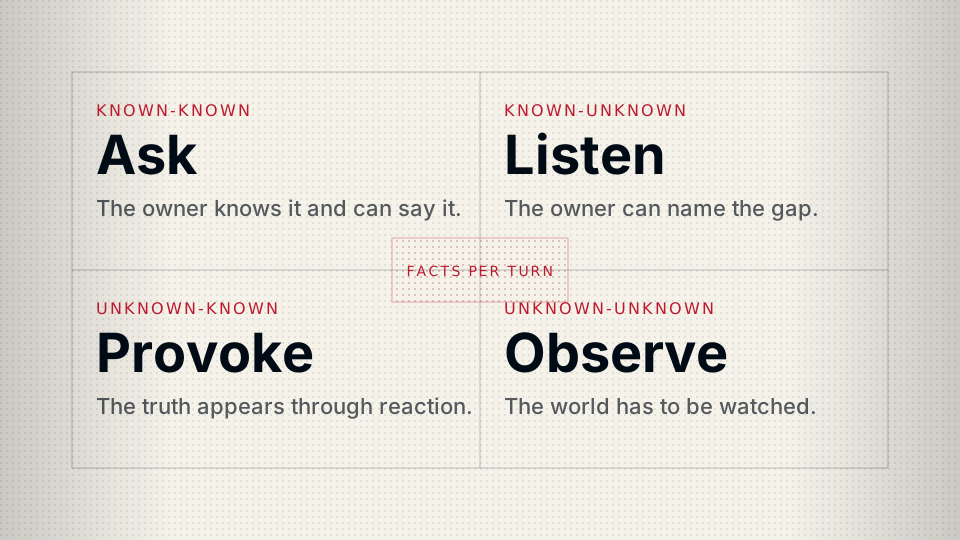
Some things are known-knowns.
The owner knows them and can say them clearly: opening hours, services, locations, prices, contact details. These are askable.
Some things are known-unknowns.
The owner knows there is a gap: "I do not know what to post", "I am not sure what customers search", "I do not know why competitors are showing up." These should be stored as needs, not treated as missing facts.
Some things are unknown-knowns.
The owner carries them, but cannot articulate them on command. These come out through correction, voice, photos, examples, hesitation, and reaction. A wrong draft can be useful here. Approval gives us one bit. A correction gives us an edge.
And some things are unknown-unknowns.
Nobody in the conversation knows to ask. A festival this Friday. A new competitor nearby. A platform rule change. A seasonal demand shift. These cannot come from the customer. They have to be observed from the world.
This is why learning the business cannot mean asking better forms.
The carrier matters
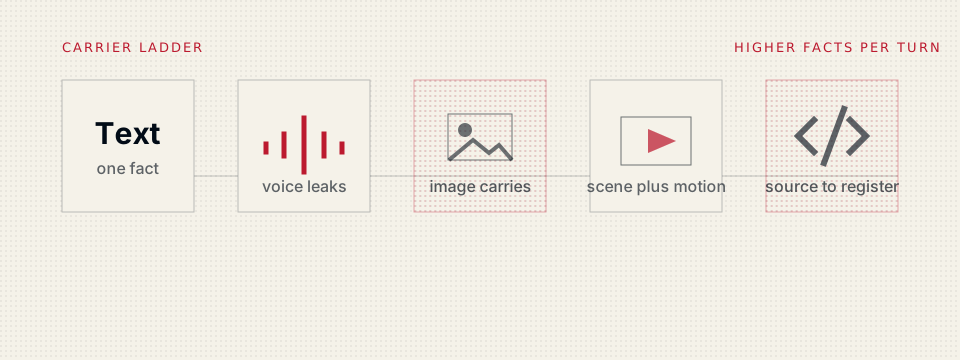
Text is the lowest-yield carrier.
A photo of a menu board can carry forty facts. A voice note can carry the aside after the point. A URL can register taste, evidence, an owned surface, or a competitor.
If we treat all of this as attachments, we miss the actual point: the medium is part of the knowledge.
So the system has to respect customer attention.
Ask only what is truly askable. Listen when the customer names a gap. Provoke when the truth is hidden inside reaction. Observe when the world has moved.
That is the layer beneath the product.
42flows is not trying to make the customer operate another machine.
It is building the workforce around the business: one that learns from the owner, learns from the public world, learns from corrections, and learns from the fleet.
The goal is not more content.
The goal is a clearer public presence: what the business is, what it should say, what it should never claim, and what the world changed around it.
Before we build, we have to know how to know.